Ship to the EU? Build this button by 19th June

There’s a new rule landing on 19 June 2026, and if you sell to customers in the EU, it will likely mean you need a small (but very much mandatory) change to your website.

It’s the kind of thing that’s easy to miss, because the law it comes from sounds like it has nothing to do with you. So let’s clear that up.

The short version

From 19 June 2026, online shops selling to EU consumers need to provide a “withdrawal button”: a simple, obvious way for a customer to cancel an order online, just as easily as they placed it.

That’s really the whole idea. The EU looked at how hard some businesses make it to cancel (buried forms, “email us” with no reply, a phone number that rings out) and decided that backing out of an online purchase should be as painless as buying in the first place.

If it took one click to buy, it should take roughly one click to cancel.

Where did this come from?

Here’s the bit that trips people up. The rule lives inside Directive (EU) 2023/2673, which on paper is about financial services sold at a distance. Read the title and you’d reasonably assume it’s a problem for banks and insurers, not your e-ecommerce store.

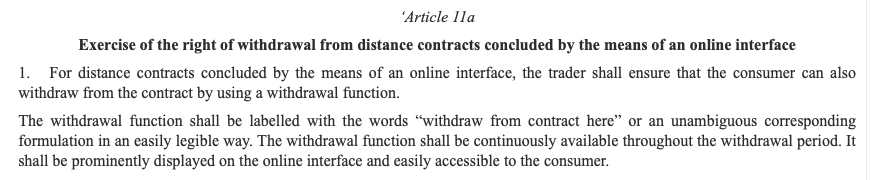
But tucked inside it is a new Article 11a, and that part is much broader. It applies to any distance contract concluded through an online interface where the customer already has a right to withdraw. In plain terms: ordinary online retailers are caught too, not just financial firms.

Worth saying clearly: This is an EU directive, not UK law. Post-Brexit, it doesn’t impact business carried out inside the UK. But, if you’re selling into the EU, it DOES affect you.

You’ll need to either follow it, or stop selling to EU customers (or risk a chunky penalty).

There are some exceptions where the right of withdrawal doesn’t apply but, if you’re currently offering a 14 day distance-selling returns policy, it’s almost certainly relevant.

What the button actually has to do

What the directive requires is less of a single button and more of a short, tidy process.

Broadly, you need:

  • A clearly labelled withdrawal function. The wording has to be unambiguous, something like “withdraw from contract here.” No cryptic icons, no making people hunt for it.
  • It has to be easy to find and available throughout the cooling-off period. The standard EU cooling-off window is 14 days, and the function needs to be prominent and continuously available for that whole time.
  • It can’t hide behind a login. This is the one that catches people out. You can’t tuck it away so that only registered, logged-in customers can reach it. Guest shoppers who never made an account still need to be able to cancel, so the function has to be reachable without a prior login.
  • A confirmation step. The customer fills in or confirms their details, then submits via a separate “confirm withdrawal” function.
  • A receipt on a durable medium. After they confirm, you send an acknowledgement (an email is the usual route) without undue delay, with a record of the content and the time. That timestamp protects both sides.
  • And no charging customers to use it.

A couple of things people get wrong

“So I need this on the My Account page?”

That’s a fine place to put it, but there then needs to be a way of getting to that page without logging in (from a confirmation email link, or order ID + Email Address). Think of it as something a customer can always find, whether or not they have an account.

“Does it matter if I’ve already shipped?”

The button is tied to the cooling-off window, not to whether the parcel has left the building. It needs to work throughout the 14 days. It also doesn’t invent a new right to cancel. It’s just an easier way to use the cancellation right that already exists, and the usual exceptions still apply. Made-to-order items, perishables, and unsealed hygiene products, for example, are typically not subject to withdrawal in the first place, so they’re outside this.

How chunky are the penalties?

Chunky enough to take seriously. The EU’s Omnibus Directive already toughened enforcement of consumer rules, and authorities can levy fines of up to 4% of annual turnover for widespread infringements, or up to 2 million euros where turnover figures aren’t available, with individual countries free to go higher. We’ve seen in the past that some countries will start pursuing enforcement from day 1, so this is worth getting right asap.

There’s a quieter risk too. If you don’t provide a compliant way to withdraw, a customer’s cancellation can still count as valid even if you never process it. So a missing button doesn’t make the cancellation go away. It just means you’re on the back foot, possibly out of pocket, and potentially non-compliant all at once.

On Shopify or WooCommerce? Don’t think it will be taken care of for you

This is where a lot of store owners assume their ecommerce platform will already handled for them. It doesn’t.

Neither Shopify nor WooCommerce ships a compliant withdrawal function out of the box. They both have cancel and refund tools, but those are designed for you, the merchant, to use from the admin side. They don’t meet the customer-facing requirements here: the prominent, clearly labelled button, the two-step confirmation, the guest access without login, and the automatic acknowledgement email. So having a refund button in your dashboard does not tick this box.

In practice that leaves you two routes:

  1. A plugin or app. There are already several plugins for WooCommerce and apps for Shopify built specifically for this directive, most of which handle the button, the confirmation step, guest access, and the email for you. If you go this way, check it actually covers all the requirements (especially guest withdrawal without a login) rather than just adding a button somewhere.
  2. A custom build. If your setup is bespoke, or you want it to behave exactly the way you’d like, this can be coded in. It’s not a huge piece of work, but it does need doing properly so the flow is compliant and the records are kept.

One honest note: the button is the easy part. The bit that actually matters is what happens after a customer clicks it, namely processing the withdrawal and refund within the legal window, reliably, even when a few come in at once. Whichever route you take, make sure the back end keeps up, not just the front end.

What to do now

With the deadline days away rather than months, this is a “check it this week” job if you ship to the EU:

  1. Work out whether you actually sell to EU-based consumers, and for which products a withdrawal right applies.
  2. Look at how someone cancels on your site today. Is it obvious? Can a guest do it without logging in? Could they do it in under a minute?
  3. If the answer is “not really,” map out a simple flow: a clearly labelled withdrawal function, a confirmation step, and an automated email acknowledgement with a timestamp.
  4. Sort out how you’ll deliver it. If you’re on Shopify or WooCommerce, that almost certainly means a plugin or app, or a custom build, since it isn’t there by default.
  5. If you’re unsure where you stand legally, get proper advice on your specific situation.

None of this is dramatic. It’s a small, well-defined piece of UX, and arguably the kind of thing a good checkout should have had anyway. Making it easy to leave tends to make people more comfortable arriving in the first place.

If you ship to the EU and you’d like a hand working out what your site needs, that’s exactly the sort of thing we enjoy. Give us a shout.

Google API Leak – What does it mean for Search Engine Optimisation?

What Google API Leak?

Earlier this month, documentation from Google’s Search Content Warehouse API was published on GitHub by an automated bot. This documentation included over 2,500 pages detailing:

  • Search Ranking Factors: Detailed information on over 14,000 metrics that Google uses to rank search results
  • Quality Rating Data: Information about how Google’s quality raters assess the relevance and quality of search results
  • Clickstream Data: Data from Chrome browsers that helps Google understand user behaviour
  • Algorithm Adjustments: How search results are tweaked based on user navigation and click data

It’s safe to say that all it has caused a bit of an upset in the search engine community. Mainly because although everyone claims to understand how to do well in search engines, the way that Google’s search algorithm actually works is a closely guarded secret, and this leak provides never-seen-before access to the algorithm’s inner workings.

As a result, since it was discovered, a whole range of Search Engine Optimisation experts have been poring over the documents and trying to work out what it can tell us.

Was it really an accident?

Yep, it appears so. The data was exposed quite a while back (since 2023, it’s just taken until this month for someone to find it!), and since it’s been found it’s been corroborated by a few pretty knowledgeable sources – this information wasn’t meant to be out in the wild [Update: 30th May – Google has now verified the documents are real].

Does the Google API leak actually tell us anything?

Again, yep, it appears so.

The leak tell us about all sorts of metrics that Google collects and uses to create its search results. Whilst it doesn’t tell us how these are weighted, or to what degree these metrics are ‘ranking factors’ in the algorithm, it does help us better understand what might important.

It also suggests that Google hasn’t been ENTIRELY accurate in some of the statements it’s made in the past about it’s algorithm.

Whilst we’re not going to throw the baby out with the bathwater and solely focus our SEO on what the leak contains going forward, we are definitely going to adjust our strategy and use the insights to focus on some new areas – as well as to run some tests around some of the things we’ve learned to see whether there are any new opportunities.

What are the BIG lessons that might affect your SEO?

There’s a LOT of detail in the documents so it’s tricky to work out what’s important and what’s not. Here are 7 key takeaways that we’ve spotted:

1. Clicks & Engagement are key

The quantity and quality of clicks from organic rankings matter.

Recent information from the Google antitrust trial revealed that Google’s Navboost system is an important ranking signal. This uses Chrome click data and quality raters to work out what are ‘good’ web pages.

The leak though shares some of the metrics it uses to calculate this. For example, it measures data like the search result a user spent the longest time on, or the last time somewhere came to your site and hung around – and it tracks clicks over 13 months.

Creating demand for your website among targeted searchers is key. The best approach for that is focussing on high intent search queries, and making sure your content is useful and sticky.

BTW, this also suggests that there could be a SEO effect from paid advertising. Possibly not the paid clicks, as Google could discount those fairly easily, but the secondary clicks you get from paid marketing (when people come back to your website after finding you in ads) might give you a natural search boost – so this could be a great approach to drive long term organic performance.

2. Know your niche

Despite Google suggesting otherwise in the past, there are a lot of metrics mentioned that reference ‘site wide’ scores, including “siteAuthority” to “siteFocusScore”.

It’s not clear how these are calculated, but given they exist, and taking them together with Google’s focus on quality content (EEAT as they put it –  Experience, Expertise, Authority, and Trust), it’s likely that having your site engaging useful content, focused on your core subject matter is going to result in higher scores.

EATT Diagram showing intersecting circles, with Expertise, Experience, Authoritativeness and Trust
Google’s focus is on content the reflects the concepts of EATT

3. Be original 

Continuing the EATT theme, it’s clear based on the documents that Google is looking for quality original content.

Pages that only include small amounts of content receive an “OriginalContentScore”, which reinforces the need for unique, authentic, quality content. There also appears to be an AI rating for Content Effort – though how exactly this is being measured it’s not clear.

This does though mean that it’s worth focussing on pages with shorter content to make sure they’re original. It also suggests that relying heavily on AI tools like ChatGPT to generate content is likely to cause issues for you down the line. Instead, take the human approach, focus on adding value for your readers, and try to differentiate your content from your competitors.

4. Fresh is best

Google measures content recency and freshness, with metrics to track both the publication and update dates. It clearly wants to prioritise content that is curated and kept up to date.

With that in mind, it’s important to review all the content on your site to keep it fresh and relevant. For instance, if you’re in accountancy, make sure your site is updated to reflect the latest tax advice.

If a page isn’t relevant any more, its better to take it down – even if it does still get the occasional visitor!

5. Google likes to mix it up

The API documents suggest that Google takes steps to make sure there’s a range of different content sources in the results – limiting the number of videos, small site blogs etc. to give users a range of different sources in response to their query.

To get broader coverage in search results, it’s then a good idea to create a diverse range of content types on your site to improve overall visibility.

This is particularly important for sites trying to enter really competitive areas. For example, if you’re trying to gain traffic in markets where there are already lots of ecommerce sites at the top of the results, maybe consider video content as a way to more effectively compete.

6. Spammy links will hurt you

Links from established sites, using proper anchor text, are great, but a load of links from dodgy websites with over optimised anchor text seems to trigger a spam penalty.

Skip the link building services and instead use an organic approach – or focus on quality PR and build relationships with high quality websites that are relevant to your audience.

7. The experts get things wrong

There are a couple of things that we all thought were important that don’t appear to be – in particular, it appears that character limits on page titles and descriptions don’t need to rigidly stick to the character counts – especially if it improves readability

Also, internal linking doesn’t seem to have the benefit most experts thought – so just link to other pages when you want to signpost them to users, rather than worrying about search engines.

Keeping Ahead of Google’s Algorithm

This leak isn’t a silver bullet! We don’t have the whole algorithm, we don’t know to what extent each metric is used as a ranking factor, and we don’t know how up to date this is (although it’s certainly less than 12 months old, based on timestamps).

Whilst there’s clearly some great information in there that helps inform how we can get better at search engine optimisation, it does broadly align with the core message that Google’s been sending out for years now – we should be focussed on creating high quality, useful content that is interesting to our users. This means that, no matter what else, we’ll be well placed to react to new shifts in Google’s algorithm.

In the meantime, we should be testing out the key ideas the leak has suggested, to see the impact they have on search results – and what can give us the edge. We’ll share what we find along the way!

Need help?

Want to know more about how your site can more traffic from search engines? Get in touch and we can talk you through how you can improve.

Curious during Covid-19

With the current outbreak of COVID-19 and the impact the virus is already having on our countries, customers, our team and their families, we wanted to share information about how Curious is preparing for any further disruption.

Despite the uncertainties that COVID-19 brings, we fully expect to maintain the same level of service excellence to our customers. Our team is set up to connect with our network, colleagues and our customers from wherever they may be, and we’re confident we can continue to help your businesses wherever we’re required to work from.

Our technical platform is fully automated and we’re able to resolve any hardware or software issues without requiring engineers on site. Our technology partners, who provide our hardware are chosen for their resiliency and sophistication whose practices are designed to handle this sort of issue as smoothly as possible.

Thank you so much for trusting us with your business-critical websites. We take this responsibility very seriously and will continue to work hard to ensuring we deliver on our promise to you.

As ecommerce specialists, if your business needs any help or advice as to how you can continue to serve your customers over the coming months, please don’t hestitate to get in touch. We’ll do everything we can to help.

Many thanks

The Curious Team

Zokit Business Award for Customer Focus – We won!

We had a great day at the Zokit SpringConf on Thursday, meeting businesses from across South Wales.

The day was topped off by Curious winning Zokit’s Customer Focus Award,  recognising businesses that have exceptional customer service throughout the whole customer journey.

We’re massive advocates of focussing on your customers’ experience, and so couldn’t be more proud to take the trophy home.

Simon looking rather pleased after getting through his acceptance speech!